Crime & Law
‘This Was the Defendant’s Racket’: Opening Statements Underway in Ex-Speaker Michael Madigan’s Landmark Corruption Trial
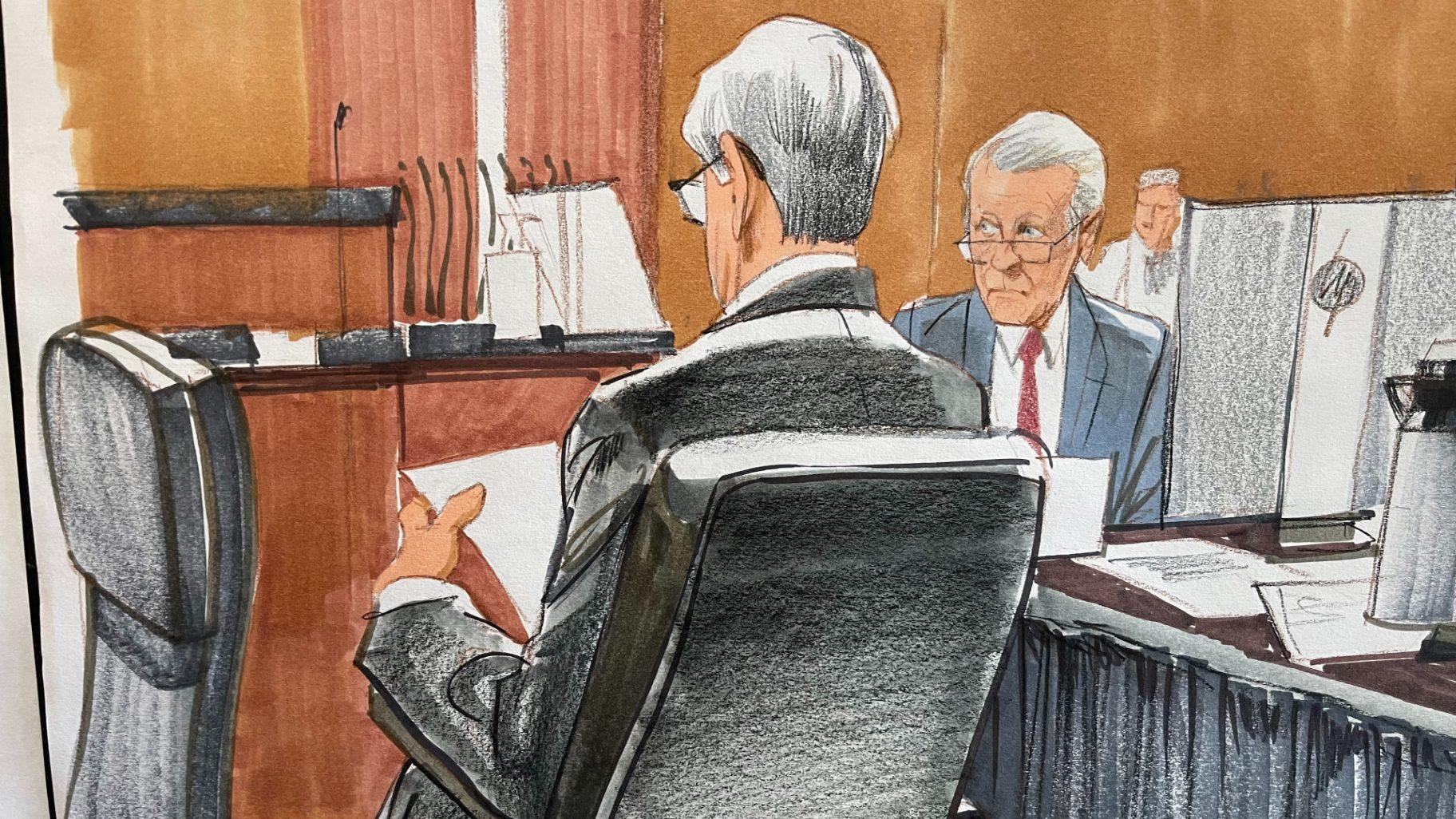 Former Illinois House Speaker Michael Madigan in federal court on Oct. 21, 2024. (Illustration by Cheryl Cook)
For nearly a decade, Michael Madigan exploited his immense political power and control in Springfield to seek and accept bribes, trading his public office for private gain, federal prosecutors alleged Monday as arguments in the former Illinois House speaker’s landmark corruption trial got underway.
Opening statements began at the Dirksen Federal Building Monday afternoon after eight days of jury selection as Madigan and his longtime confidant Mike McClain face charges of racketeering, bribery and wire fraud.
“From 2011 to 2019, Madigan abused his power and used the organizations he led to engage in a pattern of corrupt conduct over and over and over again — what’s known as racketeering — the trading of public office for private gain enriching himself and his allies through bribery,” Assistant U.S. Attorney Sarah Streicker told jurors Monday.
Madigan, seated at his defense table wearing a charcoal gray suit and red tie, took notes throughout opening statements. His wife, Shirley, and daughter, former Illinois Attorney General Lisa Madigan, were both present in court Monday for the first time since proceedings began earlier this month.
Streicker on Monday repeatedly referred to Madigan as Illinois’ most powerful politician, saying he wielded almost complete control over the state House with his ability to kill legislation in numerous ways.
“This is why companies who needed legislation sought to influence him,” Streicker said.
But the speaker’s decades-long grip on power began to erode in December 2020 when Commonwealth Edison officials admitted the utility giant arranged jobs, contracts and payoffs for Madigan’s associates to win Madigan’s crucial support.
Ultimately, Streicker alleged, Madigan arranged for $1.3 million in contracts for his “political cronies” who did little or no work.
“This was the defendant’s racket,” Streicker said. “The corruption of public office for private gain.”
Madigan attorney Tom Breen disputed that, claiming instead that the government’s case was built around “some out-and-out lies.”
“(Streicker) is relying on bad information,” Breen said. “She is relying on unreliable sources and she is relying on guesswork and speculation. The evidence will not support a finding of guilty.”
Breen said Madigan wasn’t some “all-powerful individual,” but instead came from humble beginnings and a blue-collar family following the Great Depression, and only became interested in politics because he wanted to help those around him.
Breen also described Madigan as “incorruptible” and said he would never enter a bribery scheme because “jobs did not influence him.”
“It didn’t happen,” he told jurors. “That’s not who he is.”
Streicker on Monday claimed McClain served as Madigan’s “mouthpiece” by carrying messages and disguising Madigan’s involvement in “corrupt activity.” Together, she said, the pair engaged in a “campaign of bribery” that lasted more than eight years.
According to Streicker, McClain described himself as a “soldier and surrogate” for Madigan, regularly carrying out the House speaker’s “dirty work.” When McClain made a request in Springfield, Streicker said, those on the receiving end knew it was coming from Madigan.
“When Madigan didn’t want his fingerprints on something, he assigned McClain to handle it,” Streicker said. “This was a role that McClain relished.”
Prosecutors have alleged there are five separate schemes that will be outlined at trial and argued those schemes often occurred simultaneously, as Madigan and McClain were sometimes recorded on government wiretaps discussing multiple conspiracies over the course of single conversations.
Streicker estimated jurors will hear more than 200 recorded conversations during this trial.
The most substantial of the alleged schemes involves ComEd. The two defendants are accused of arranging subcontractor jobs for several of the former speaker’s associates — including 13th Ward precinct captains Ray Nice and Ed Moody, and former Chicago Alds. Frank Olivo and Michael Zalewski — with the utility giant, which paid out more than $1 million to those individuals even as they did little or no work.
ComEd allegedly did this in order to win Madigan’s approval on legislation favorable to the company in Springfield.
“It was clean for all of us,” John Hooker — ComEd’s former head of legislative affairs, whom prosecutors described along with McClain as the “masterminds” of the alleged plan to pay Madigan’s allies off the books as subcontractors — allegedly said in a wiretapped conversation.
Last year, McClain, Hooker and two other ComEd officials were convicted of conspiring to bribe Madigan in the “ComEd Four” trial, though those defendants are seeking to have those verdicts tossed out.
Streicker told jurors Monday that the benefits Madigan received all lined up with important legislative votes for ComEd.
“Madigan wanted, ComEd gave and ComEd got,” Streicker said, repeating a line prosecutors similarly used during the “ComEd Four” case. “That’s what the evidence will show.”
Prosecutors have also alleged that between 2017 and 2018, Madigan and McClain were also working with the president of AT&T Illinois, Paul La Schiazza, to solicit bribes from the phone company.
They allegedly did so by arranging for AT&T to indirectly pay ex-state Rep. Eddie Acevedo, another Madigan ally, $22,500 over nine months even though Acevedo did no actual work for the company.
Another scheme outlined by prosecutors involved Madigan allegedly offering to help disgraced former Chicago Ald. Danny Solis secure a position on a state board in exchange for Solis referring legal business to Madigan’s law firm.
Prosecutors also expect Solis to testify about Madigan’s alleged efforts to illegally steer business to his private property tax law firm amid efforts to develop a state-owned parcel of land in Chinatown — which was in Solis’ aldermanic ward — into a commercial development.
What Madigan didn’t know was that Solis, who was under FBI investigation for his own bribery allegations, had agreed to work as an undercover informant beginning in June 2016, recording phone calls and conversations for the government.
Breen told jurors the FBI instructed Solis to try and “set up a phony scam” in an effort to “try to suck (Madigan) in to see if he’ll say something incriminating.” But Breen maintained there’s no evidence Madigan ever recommended Solis for any state board seat.
Breen spoke about Solis’ own bribery allegations, referring to him as a “braggart and BS’er” and told jurors “wait until you see the benefits” he and his fellow cooperating witness — ex-ComEd executive Fidel Marquez — received from the government.
Both men have pleaded guilty to bribery charges but are expected to avoid prison time after agreeing to aid government investigations.
“There was no connection, none, between what he may have asked for and his official actions,” Breen said. “The desperate script, written for Solis to deliver, to get Madigan, failed. It failed miserably.”
McClain’s defense team is scheduled to begin its opening statements Tuesday.
Jury Selection Finished Monday
The extensive jury selection process involved potential jurors being questioned at length — sometimes for 45 minutes or longer — about an array of topics including their media consumption, where they live, any political ties and their thoughts on politicians who serve for life.
Following days of methodical questioning, attorneys in the courtroom Monday appeared ready to begin opening statements and get to the evidence portion of the trial.
“I’ll tell you, we are close,” Madigan attorney Todd Pugh told jurors at the start of proceedings Monday morning.
One of the alternates selected Monday was a former University of Illinois Chicago social works professor, but she said she had never heard of longtime political observer Dick Simpson — a UIC political science professor who is expected to testify for the government in this case.
The final alternate chosen was a United Airlines airline mechanic and longtime resident of Chicago’s 47th Ward. He said he would be happy to serve on the jury, despite the expected trial length.
“Our government doesn’t ask us citizens to do too much, but it does ask us to serve on a jury,” he said. “That’s the least I could do.”
This is a developing story.